
In matters concerning your financial welfare, the choice of a saving account plays a central role. In the USA, through traditional savings accounts and High-Yield savings accounts, this paper will compare the advantages and disadvantages that come with the two accounts. Familiarizing with such options prepares you for making a decision that favors your financial capabilities.
Traditional and high-yield savings accounts are both well known, but it should be noted that these offers have certain features that must be compared. Now let’s look at the detailed properties of each type to see which one would be suitable.
The basics: traditional and high-yield savings accounts
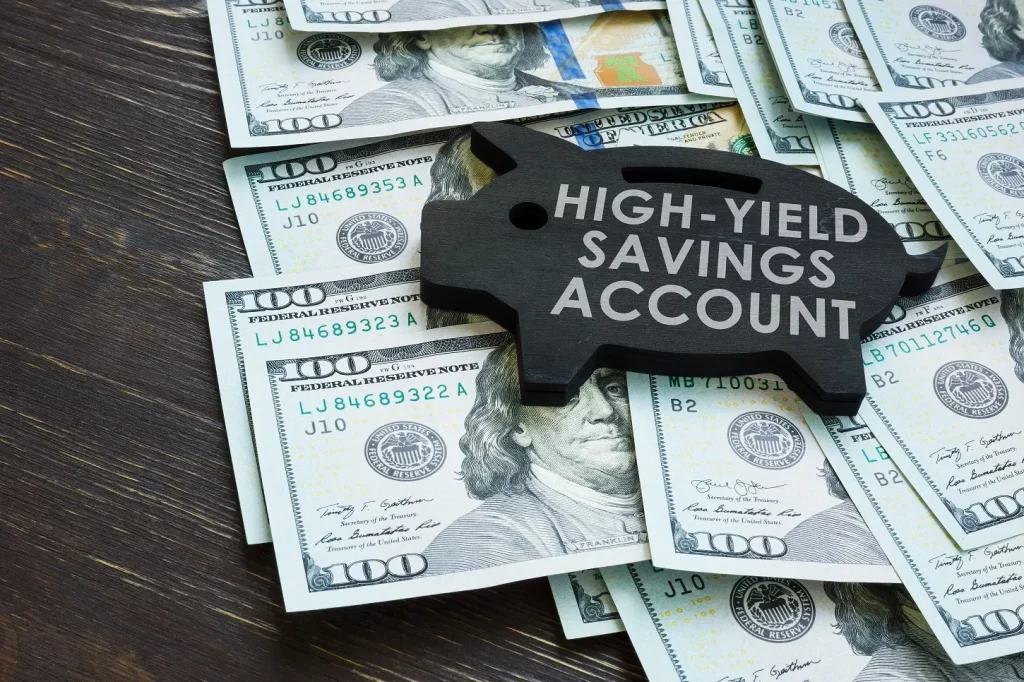
A conventional saving account is generally provided for by physical street-side banks as well as credit unions. Such accounts are easy to open and are usually charged with lower interest. It offers the preservation of the money as well as a very small level of return.
On the other hand, high-yield savings account is mainly available in online banks and institutions. These accounts provide higher interest rates than the conventional accounts, in the society. The main reason for such difference is the fact that Online banks have a lesser overhead to make, therefore, they get to pass it down to consumers.
Accessibility and convenience
Hence, for the aspect of accessibility, the conventional saving deposits are somewhat more favorable than the money market deposit accounts. By the large number of branches and ATMs you have convenient opportunities to use your funds.
Furthermore, such accounts may include choices of the face-to-face service where people can turn for the help if they have a number of problems connected with personal finance or if they are uncomfortable with the Internet communication.
On the same note, high yield savings accounts are normally operated online. Though this perhaps implies that you cannot physically grab your money when you need it, the advantages of electronic banking cannot be gainsaid. Customers are able to view their balance, perform a money transfer and access their account even if they are not physically present on the vicinity of the bank.
Interest rates and earnings potential
This lender’s interest rate is one of the most distinguishable features between these two accounts types. Standard savings accounts come with lower interest rates; in most cases rates below 0. Thus, the compound interest rate is as follows: 1% annual percentage yield (APY). This means that they are not suitable for those who would wish to increase their amount of savings within a short span.
High yield savings accounts as the name suggests provide much higher interest rates that may be over 1% APY. This can hammer a huge dint in the rate of return that you earn with your interest over time. The more the interest rate charged the faster the amount saved will earn interest and hence earn the required targets in the set measured time.
Security and peace of mind
Although traditional as well as high yield savings accounts are regarded to be secure places to place your money. They are often bonded by the Federal Deposit Insurance Corporation (FDIC) relating to the banks as well as the National Credit Union Administration (NCUA) with reference to the credit unions. This insurance is a reassurance to the depositor since their funds are shielded up to $250,000 per depositor.
Nevertheless, it needs to be stated that even in the field of raising interest rates, high-yield savings accounts do not differ from their traditional counterparts in terms of security. The chief distinction, however, is based on how the account operates, and the interest rate earned on it.
Fees and minimum balance requirements
It is important to note that with most standard saving accounts come with various charges and specified balance which a saving account holder has to meet. This may include; Monthly maintenance fees, minimum balance required to open the account, balance fees for not balancing up to a specific amount.
Traditional savings accounts or the high-yield savings accounts usually are associated with fewer fees and lower balance requirements especially if offered by an online institution. Hence, they can be more convenient for people especially those who may not afford a huge amount of money they intend to save or those who are just beginning their savings plan.
Deciding what’s best for you
Making a decision between a normal savings account with conventional interest rate and a high yield account is more of a matter of personal preference based on the individuals needs. If you prefer to have the physical touch and get your banking services without strict measures a traditional account is the right one for you.
However, if earning the highest amount of interests possible is your major concern, a high-yield account solution can prove to be more beneficial. Take the frequency of use of the funds, the type of services you expect, and whether you are ready to do most of the banking online. This way, one is in a better position to evaluate and likely choose the best saving’s account depending on all these factors.
